

Local Property Context
Planning Exterior Work in St. Louis
St. Louis is an independent city with its own Building Division, permit process, zoning framework, and Cultural Resources Office. That matters when a homeowner is comparing roofing, siding, fascia, soffit, or gutter work with rules in St. Louis County or a separate municipality. Gray Summit Roofing schedules inspections from Pacific, Missouri, while appointment timing depends on availability. This guide is a practical starting point for city homeowners, not a legal opinion or a substitute for confirming the current requirements for a specific property. The city identifies 79 neighborhoods, including older, closely settled areas such as Soulard, Lafayette Square, Shaw, Benton Park, The Hill, Tower Grove East, and Tower Grove South, as well as north-side neighborhoods and corridors such as Baden, Hyde Park, Old North St. Louis, The Ville, and Wells Goodfellow. Those names help describe where a property sits, but they do not by themselves determine whether a permit or preservation approval is needed.
Project-Site Photos
Project-Site Documentation: St. Louis Area
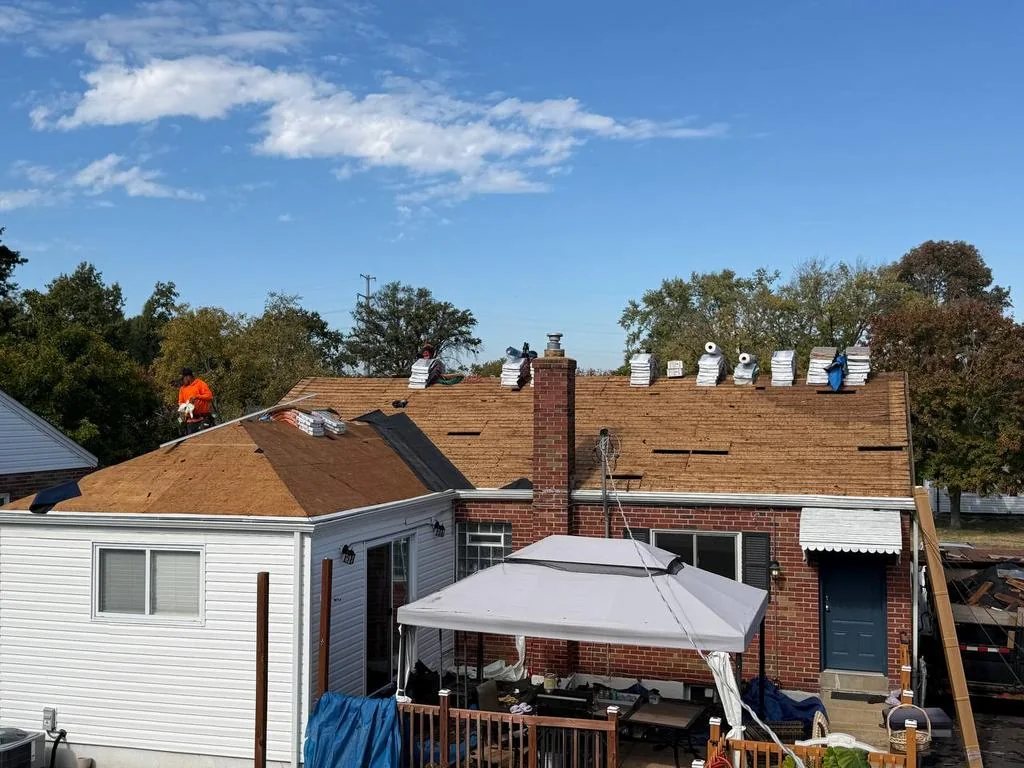
Photos document local project work, not a crew's current location. Ask our Pacific office about inspection and production scheduling.
Start with the City of St. Louis permit question
For ordinary residential repairs, the city says many maintenance items do not require a building permit. Its published criteria specifically list roof replacement with like material when 25% or less of the roof sheathing is replaced as work that usually does not require a permit. The same page lists replacement of gutters and downspouts as usually permit-exempt, and it lists new aluminum, steel, or vinyl exterior siding when existing openings do not change as usually permit-exempt. These are useful screening rules, not a blanket approval for every project.
A permit is required for an entire new roof when the work is not replacement of like material or when more than 25% of the roof sheathing is removed and replaced. Structural repairs, changes to openings, additions, and related electrical, mechanical, or plumbing work can create separate requirements. Before signing a scope, the homeowner should describe the actual layers, sheathing condition, structural repairs, penetrations, and accessory work to the City Building Division and ask which approvals apply.
Roofing, siding, and gutters need different checks
A roof inspection should distinguish a like-for-like covering replacement from work that exposes or replaces substantial sheathing, changes the roof assembly, or repairs structural supports. For siding, the city’s criteria distinguish new siding with no change to existing openings from projects that alter the building envelope or openings. For gutters and downspouts, ordinary replacement is listed among work that usually does not require a residential building permit, but historic-district rules can change that result.
Ask the contractor to put the proposed material, tear-off extent, sheathing allowance, flashing, ventilation, siding openings, and downspout discharge approach in writing. Then confirm the permit question with the city before work begins. The city’s published criteria also note that flood-area construction may require a Floodway Development Permit even when a building permit is not required, so a property in a mapped flood area needs an additional check.
Historic districts and landmarks are a separate layer
St. Louis has city historic districts and City Landmarks, and the Cultural Resources Office reviews exterior work in those areas. The city’s permit guidance says that, for a City Historic District or City Landmark, approval may be required for exterior painting, gutters and downspouts, windows, doors, tuckpointing, fences, awnings, and similar exterior work even where the Building Code would not otherwise require a permit. The Cultural Resources Office explains that no permit may be issued without its or the Preservation Board’s approval for covered exterior work.
This is not the same as an HOA rule. A historic designation is a public city review; an HOA or condominium association is a private, property-specific set of covenants and approval procedures. Homeowners should check the city’s historic map or ask Cultural Resources whether the parcel is covered, and separately review their deed, declaration, or association rules if the property belongs to an HOA or condominium community. Do not assume a neighborhood name alone proves historic coverage.
Neighborhood context helps plan the inspection
The city’s neighborhood directory is unusually useful for locating a property within its own civic context. South-city areas include Carondelet, Holly Hills, Southampton, St. Louis Hills, Princeton Heights, and Lindenwood Park. Central and west-central areas include the Central West End, DeBaliviere Place, Skinker DeBaliviere, Forest Park Southeast, Shaw, and Southwest Garden. North-city areas include College Hill, Fairground, O’Fallon, Penrose, Walnut Park East, and Walnut Park West. The official directory also includes Downtown, Downtown West, Midtown, and the Near North Riverfront, where building types and access conditions may differ from detached-home blocks.
These distinctions can affect what an inspector should look at without supporting a one-size-fits-all construction claim. On a dense older block, the inspection should document shared-looking party-wall conditions, parapets, flashing transitions, roof access, and drainage paths rather than assume the neighboring wall or downspout is part of the same property. On a detached-home lot, the inspection should still verify where water lands and whether a downspout or extension affects adjacent property. The property’s actual design and ownership documents control.
Confirm the code edition and approval path
The City of St. Louis Building Division lists the 2018 International Residential Code, 2018 International Building Code, 2018 International Existing Building Code, and 2018 International Property Maintenance Code among the city-adopted codes. It also lists a 2018 International Energy Conservation Code and separate mechanical, fuel-gas, fire, plumbing, electrical, and zoning ordinances. A code edition on the city website is a useful reference, but the homeowner should ask the city about amendments, current administrative practice, and which code applies to the actual scope.
Missouri Department of Natural Resources likewise cautions that jurisdiction lists may not include local amendments or every trade code and recommends contacting the local jurisdiction for specific details. For a St. Louis city project, that means the City Building Division is the first permitting authority to confirm, while Cultural Resources is the additional public reviewer when a landmark or historic-district property is involved. St. Louis County or a municipality in the county is not the authority for a property inside the independent City of St. Louis.
A practical pre-work checklist
Before scheduling work, gather the property address, parcel or ownership information, photos of each roof slope and exterior wall, the proposed material and color, and a written description of any sheathing or structural repair. Ask the City Building Division whether the scope needs a building permit, whether a flood-area approval is relevant, and whether separate trade permits are triggered. If the parcel is a City Landmark or in a City Historic District, ask Cultural Resources what exterior approval and drawings are required before ordering materials.
If an HOA or condominium association is involved, request its current architectural-review procedure and written approval requirements from the association or management company. Gray Summit Roofing can discuss observed conditions and a proposed scope, but the homeowner should obtain the actual authority’s answer for the property before work begins. Keep permits, approvals, material selections, and the final scope together so later maintenance decisions can be compared with what was actually approved.
Roofing & Exterior Services
Local Sources & Permit Contacts
The local guidance above draws on these public sources. Permit scope, adopted codes, historic review and association requirements can change; confirm the rules that apply to the actual property before signing a scope.