
Hail Damage to Your Roof in O'Fallon, MO? Here's What to Do Next
If you suspect hail damage to your roof in O'Fallon, MO, stay off the roof, document what you can safely see, and arrange a professional inspection. Contact your insurer promptly about reporting requirements if damage is suspected. Do not assume a roof needs replacement because a nearby home does—or dismiss damage because yours is not leaking.
The useful next step is a documented assessment that separates actual shingle damage from surface changes and identifies which roof areas need work. Gray Summit Roofing LLC serves Greater St. Louis and can assess construction damage and provide a written estimate; your insurer decides coverage under your policy.
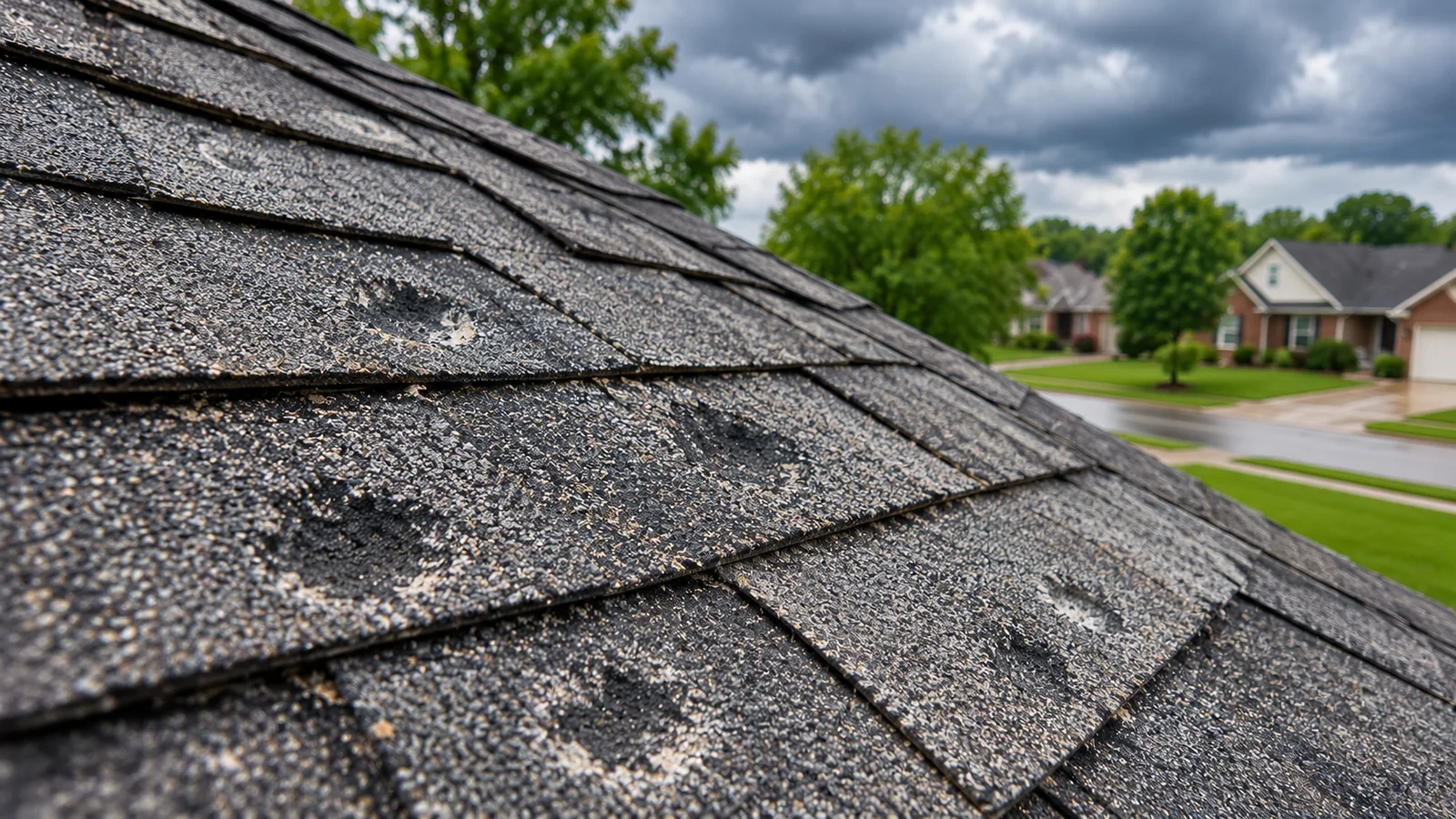
What to do safely after the hail stops
Wait until severe weather has passed before going outside. From the ground, photograph visible damage to gutters, siding, screens, or vehicles. If hail remains and conditions are safe, photograph it beside a ruler. Record the date, approximate time, and when you first noticed any indoor water stains. Keep earlier roof photos or inspection records for comparison.
Do not climb a ladder, walk the roof, or attempt to install a tarp. Ask a professional to handle temporary roof protection. Keep away from sagging ceilings and water near electrical fixtures; those conditions need qualified help, not a closer homeowner inspection.
For O'Fallon homeowners, the National Weather Service St. Louis office provides warnings, storm reports, and event summaries. Save relevant weather information with your photos. A report near your neighborhood helps establish storm context, but it cannot prove what happened to an individual roof.
What hail damage looks like on asphalt shingles
An inspection should look beyond dark spots. Hail can leave irregularly distributed impact depressions, cracks, or areas where the protective surface has broken away. A bruise may involve damage beneath the visible surface, including the shingle's reinforcing fiberglass mat. A color change alone does not establish that damage.
GAF's hail-damage technical bulletin identifies surface indentations, radiating cracks, exposed fiberglass, and mat fractures as possible impact damage. Some effects may not be immediately visible. That supports careful assessment—not a prediction that every mark will become a leak.
Ask the inspector to explain what each photograph shows: an impact depression, a crack, exposed material, or an uncertain surface mark. Suspected bruising needs professional evaluation rather than homeowner pressing or scraping. Documentation should distinguish observed damage from suspected damage and avoid labeling every blemish as hail.
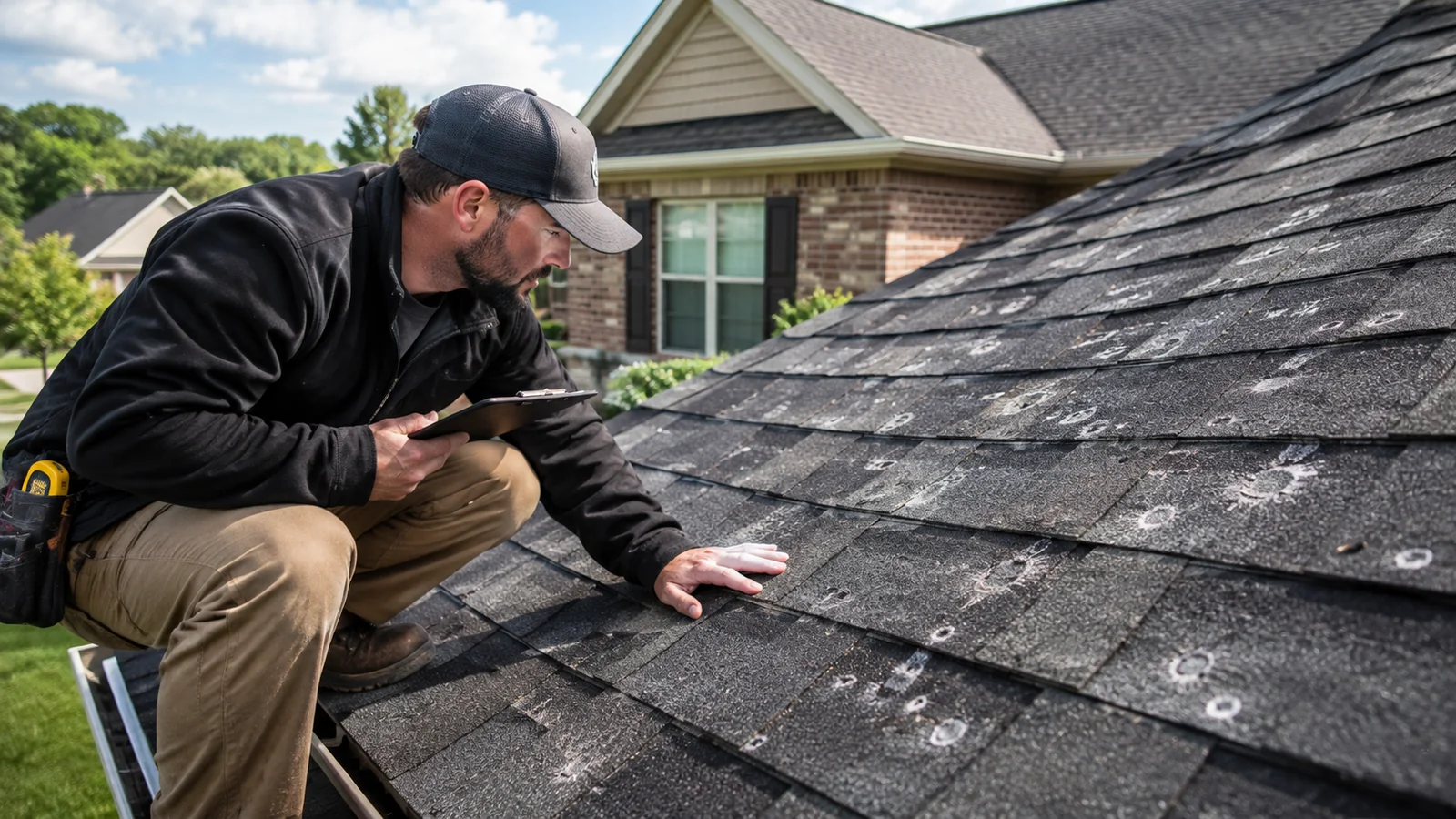
Why granules and flashing dents are clues, not verdicts
Granule loss alone does not prove hail damage. Loose granules in a gutter do not identify their source or the cause of shedding. GAF explains that new shingles can shed excess manufacturing granules normally. After a storm, the question is whether localized loss accompanies credible impact evidence, such as a depression or fracture.
That does not make significant granule loss harmless. Bare areas deserve evaluation because the protective surface is missing. The inspector should document the pattern and condition rather than jump straight from gutter debris to a replacement recommendation.
Dents in metal vents, chimney caps, or flashing can corroborate that impacts occurred. They are not conclusive proof that nearby shingles were damaged. Record where dents appear, whether earlier photos show them, and whether the metal component is punctured, displaced, or unable to shed water properly. Its repair needs should be evaluated separately from the shingles.
Ask for a slope-by-slope roof assessment
The roof face visible from your driveway is not the entire roof. Ask for a report that labels each slope by direction and location, documents impact findings separately, and identifies areas the inspector could not safely access. Exposure should be evaluated rather than assumed to be equal everywhere.
For a house with multiple roof faces or an attached garage, a single close-up cannot describe the whole system. Useful documentation includes overview photos showing where close-ups belong, the distribution of confirmed damage, and the condition of ridges, valleys, vents, and flashing. The report should also distinguish hail findings from separate wind damage or pre-existing deterioration.
A professional storm-damage assessment should explain the evidence and its limits. If the conclusion is uncertain, ask what remains unresolved and whether follow-up observation is appropriate. Uncertainty should not be converted into either a guaranteed replacement or an assurance that nothing happened.
How the findings guide repair versus replacement
Localized damage may support roof repair when affected shingles and components can be replaced without damaging surrounding material. The assessment should consider whether suitable replacement shingles are available and whether existing shingles remain workable. A repair recommendation needs a defined scope, not simply a promise to patch visible spots.
More extensive damage or an inability to make a sound localized repair may support roof replacement. Ask why the proposed scope covers a component, one slope, or the whole roof. Neither a neighbor's replacement nor dented gutters alone answers that question.
A site-specific estimate should account for documented damage, roof size and geometry, access, material selection, flashing details, and any decking repairs identified. Our St. Louis roof replacement cost guide explains broader estimating considerations. An estimate describes construction work; it does not determine the insurer's payment.
Keep the construction scope separate from coverage
The Missouri Department of Commerce and Insurance advises contacting your insurer or agent promptly and avoiding permanent repairs before the insurer inspects the damage. Ask how to coordinate necessary professional temporary protection, and retain receipts, inspection photos, estimates, and claim correspondence.
Review the policy's deductible, roof settlement basis, exclusions, and reporting requirements with the insurer. Ask whether replacement-cost or actual-cash-value provisions apply and whether any cosmetic-damage limitation affects the reported damage. Do not assume every policy treats the same roof condition alike.
The roofer documents construction damage and proposes a repair scope. The insurer evaluates the claim and decides coverage. Gray Summit Roofing does not guarantee approval or act as your public adjuster or attorney. If you disagree with a claim decision, request its written explanation and ask DCI about available consumer assistance.
Homeowner Questions
Frequently asked questions
Can my roof have hail damage without leaking?
Yes. A lack of indoor water does not rule out impact damage. GAF notes that some effects are not immediately visible. A documented inspection is more useful than waiting for a leak, but a suspected impact does not automatically justify replacement.
Do granules in my gutters mean I should file a hail claim?
Not by themselves. Granules do not establish the cause or extent of damage. Arrange an assessment and contact your insurer about reporting requirements. Do not let an inspection appointment cause you to miss a policy deadline.
Does dented flashing mean all my shingles are damaged?
No. Dents support investigating impacts, but shingles need their own assessment. Ask whether flashing remains watertight and whether shingle damage is documented on each slope. Metal and shingle repair scopes may differ.
Why might one roof slope need more work than another?
Do not assume equal damage across every roof face. Ask the inspector to map actual findings by slope, consider exposure, and explain repairability. A recommendation for broader work should identify the construction reasons beyond damage on one face.
What should I have ready for the inspection?
Gather the storm date, safe ground-level photos, earlier roof records, and notes about new leaks or stains. Share roof age if known. Request labeled photographs and a written scope that separates confirmed damage, uncertain findings, and recommended work.
Helpful sources
- Missouri DCI: Guidance to Missourians impacted by severe weather
- GAF Technical Advisory Bulletin TAB-R-108: Damage To Shingles Caused By Hail
- GAF: Roof Damage from Hail? Here's What to Do Next
- NOAA/National Weather Service Forecast Office St. Louis, MO
- GAF Technical Advisory Bulletin TAB-R-112: Granule Loss on New Shingles
Request a documented hail-damage inspection
For an O'Fallon roof assessment, contact Gray Summit Roofing LLC or call 314-886-1489. Request documented inspection findings and a written estimate. Based at 3132 W Osage St, Pacific, MO 63069, we serve Greater St. Louis.